Traceability systems for fermented seafood producers exporting to multiple markets
Export growth rewards fish sauce producers who can prove control without flattening the character of their craft. Buyers, auditors, and border agencies want clear evidence of where raw fish came from, how salt was handled, which tanks carried each lot, what process decisions were made, and how finished product was released.
For fermentation managers, traceability is not paperwork added after production. It is a working system that connects anchovy receiving, salting, tank maturation, nitrogen release, aroma development, blending, filtration, packing, and shipment into one defensible batch story.
SaltPulse Bioworks supports producers who need enzyme guidance within that story. As an enzyme supplier for fish sauce fermentation, we focus on plant-scale reliability, salt-tolerant performance expectations, and records that help technical teams explain what was used, why it was used, and where it was applied.
Why export traceability is becoming a production priority
Fermented seafood carries long process timelines, natural variability, and market-specific documentation requirements. A tank may mature for months. A finished shipment may combine portions from several fermentation lots. One market may request ingredient declarations and allergen controls; another may focus on origin, hazard controls, supplier qualification, or product release documentation.
A strong traceability system helps teams answer practical questions quickly:
- Which raw fish lots contributed to this finished batch?
- Which salt lots and packaging materials were used?
- Which tank, transfer, blend, and filtration steps touched the product?
- Were enzyme inputs used, and if so, where are the supplier documents and process notes?
- What batch observations support maturation, aroma maturity, and release decisions?
- Can the facility isolate affected product if a supplier issue, labeling question, or customer complaint appears?
When these answers are available within hours rather than days, export confidence improves.
The core traceability chain in fish sauce production
1. Raw fish receiving records
Traceability begins before fermentation. Receiving teams should capture supplier identity, vessel or landing information where applicable, harvest or delivery date, species, lot size, sensory condition, temperature controls when relevant, and acceptance status.
For plants sourcing from multiple landing points, the receiving record should also make segregation visible. Mixing raw material from different sources may be normal, but the decision must be recorded clearly enough to rebuild the batch history later.
2. Salt and ingredient lot control
Salt is not a minor input in fish sauce. It shapes microbial selectivity, protein breakdown pace, aroma development, and preservation stability. Export-facing records should identify salt supplier, lot number, receipt date, certificate status, storage location, and usage by production batch.
If a facility uses processing aids, enzyme preparations, caramel color, sweeteners, or other market-dependent inputs, each should be treated with the same discipline: approved supplier, lot identity, date opened, batch used, responsible operator, and supporting documentation.
3. Fermentation tank logs
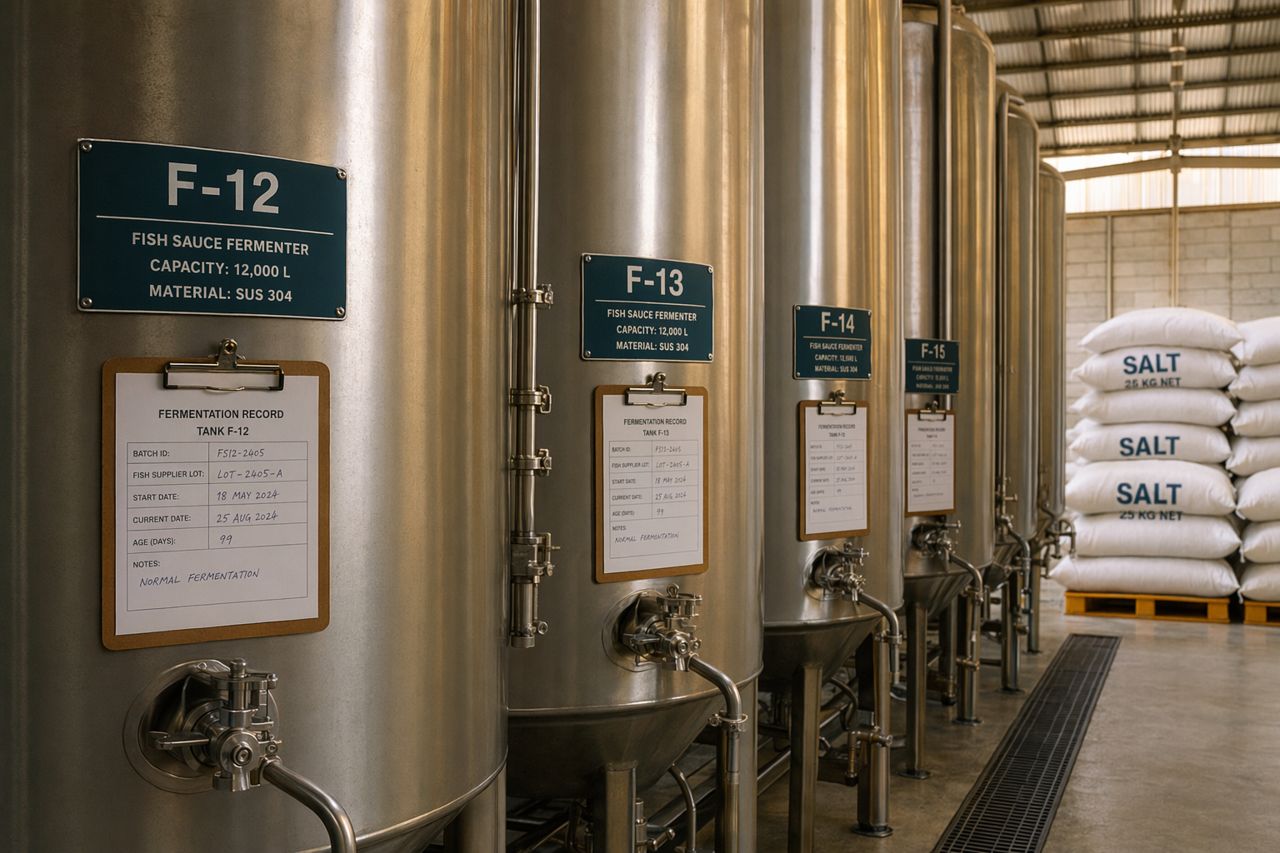
The tank log is the center of the traceability system. It should connect material input, salt ratio target, fill date, tank number, operator, batch code, interventions, sampling events, transfers, and maturation decisions.
Useful tank records often include:
- Tank identification and physical location
- Fill date and batch age
- Raw fish lot references
- Salt lot references
- Enzyme or processing aid lot references, if used
- Mixing, recirculation, or draw-off events
- Sensory notes on aroma, color, and clarity
- Key production observations linked to release criteria
- Deviations, corrective actions, and supervisor review
The goal is not to turn fish sauce into a sterile spreadsheet. The goal is to preserve craft knowledge in a format that can survive audits, staff changes, and cross-market customer questions.
Enzyme records: what exporters should keep
For producers using enzyme solutions to support protein breakdown, nitrogen release, maturation consistency, or yield stability, documentation should be specific and easy to retrieve.
A practical enzyme file should include:
- Supplier qualification record
- Product specification sheet
- Food-grade and regulatory statements relevant to target markets
- Allergen and origin declarations where required
- Lot number and receipt record
- Storage and handling record
- Batch application log
- Internal approval or trial authorization
- Finished lot linkage
SaltPulse Bioworks provides documentation designed for technical teams, purchasing managers, and quality leaders who must align production decisions with export expectations. A credible enzyme supplier for fish sauce fermentation should help the plant maintain clean records, not add ambiguity to the batch history.
Building one lot code that follows the product
Lot coding should be simple enough for operators to use correctly and structured enough for quality teams to investigate precisely. Many fermented seafood producers benefit from a hierarchy:
- Raw material lot: fish, salt, and input identity at receiving.
- Fermentation lot: tank-based batch code created at filling.
- Transfer or draw-off lot: intermediate code for product removed from a tank.
- Blend lot: code for combined product before finishing.
- Finished goods lot: packaging date, line, format, and market destination.
This hierarchy allows a producer to trace both directions: from finished bottle back to raw fish, and from a raw material concern forward to every shipment that may be affected.
Documentation differences across export markets
Exporters often serve customers with different levels of documentation maturity. One buyer may request a concise certificate package. Another may require supplier approval files, process flow diagrams, hazard analysis records, food safety certificates, packaging migration documents, label review, and full lot genealogy.
A market-ready traceability system should be modular. Keep master records consistent, then generate customer-specific document packs from the same source of truth.
Common export document categories include:
- Product specification
- Ingredient and processing aid declarations
- Supplier approval records
- Batch production record
- Tank maturation log
- Finished goods release record
- Certificate of analysis or quality statement where applicable
- Food safety certification
- Label and allergen documentation
- Recall and mock recall records
- Shipping and container records
Mock recall: the stress test for traceability
A mock recall reveals whether the system works under pressure. Select one finished goods lot and ask the team to identify all contributing fermentation tanks, fish lots, salt lots, packaging materials, and shipped customers. Then reverse the exercise: select one input lot and determine every affected finished product.
Measure practical performance:
- How long did retrieval take?
- Were records legible and complete?
- Did production, warehouse, quality, and sales data match?
- Were partial tank transfers captured accurately?
- Could export documents be assembled without rewriting history?
For fermented products with long maturation periods, mock recalls should include aged tank inventory, not only recent packed product.
Digital systems versus disciplined paper systems
Digital traceability platforms can improve speed, searchability, and multi-site control. However, software cannot compensate for weak batch logic. A disciplined paper system with clear codes and trained operators may outperform a complex digital platform that is poorly maintained.
Before buying software, define the production map:
- Receiving points
- Salting and mixing steps
- Tank filling logic
- Tank transfers and draw-offs
- Blending rules
- Filtration and finishing points
- Packaging formats
- Hold and release decisions
- Export document requirements
Once the map is stable, digitization becomes easier and more valuable.
What fermentation managers should standardize first
If the plant is improving export readiness, start with the records that protect the most value:
Tank identity and batch genealogy
Every tank should have one clear identity, one current status, and one accessible history. Partial transfers must be documented immediately.
Supplier lot discipline
Fish, salt, packaging, and enzyme inputs should be tied to approved suppliers and lot numbers before they enter production.
Maturation decision records
When a tank is considered ready for draw-off, blending, or continued aging, the reason should be recorded. Include sensory evaluation, color development, aroma profile, production observations, and supervisor sign-off.
Finished goods release control
No export shipment should leave without a finished lot code, market destination, document pack, hold/release status, and shipment record.
How SaltPulse Bioworks fits into an export-ready system
SaltPulse Bioworks works with fish sauce producers who want enzyme support that respects traditional fermentation while improving process control. Our role is to help technical teams evaluate salt-tolerant enzyme options, define application logic, document supplier records, and align enzyme use with batch consistency goals.
We do not replace the heritage of fermentation. We support the production team’s ability to manage variability, explain process decisions, and maintain reliable records across multiple export markets.
If your facility is reviewing supplier documentation, scaling enzyme-assisted maturation trials, or tightening traceability for export customers, SaltPulse can help structure the technical conversation.
Request a quote for plant-scale enzyme support
Ready to discuss fish sauce fermentation, traceability documentation, and enzyme supply planning for export production?
Request a quote using the on-site form and tell us about your tank scale, salt conditions, maturation goals, and target markets.