Salt Management in Industrial Fish Sauce Fermentation
Industrial fish sauce still depends on a patient, saline transformation: fish protein, salt, time, and microbial-enzyme activity moving together toward clear amber umami. At factory scale, however, salt is more than preservation. It is a production control variable.
The way salt is selected, dissolved, distributed, monitored, and corrected affects extraction yield, nitrogen release, aroma development, maturation time, filtration behavior, and the repeatability of finished sauce. For fermentation managers, salt management is not a side task. It is one of the main levers for making traditional character reliable across larger batches.
SaltPulse Bioworks supports factories that want to protect heritage sensory profiles while improving process control. As an enzyme supplier for fish sauce fermentation, we focus on salt-tolerant enzyme strategies that fit real brine conditions rather than idealized laboratory assumptions.
Why salinity control matters beyond preservation
High salt protects fish sauce fermentation from spoilage pressure, but it also shapes the pace and selectivity of protein breakdown. If salinity is too low in pockets of the vat, unwanted microbial activity can create harsh, unstable notes. If it is too high or unevenly distributed, enzymatic hydrolysis may slow, maturation can stretch, and soluble nitrogen release may lag behind production targets.
Inconsistent salinity often shows up as operational variation:
- Batch-to-batch differences in early liquefaction
- Uneven protein breakdown between top, middle, and bottom layers
- Delayed development of rounded umami aroma
- Higher solids load before pressing or clarification
- More frequent blending corrections before finishing
- Longer tank occupancy and less predictable release timing
Good salinity control gives the fermentation team a narrower operating window and a clearer path from raw fish intake to final blending.
The salt curve is not flat inside the vat
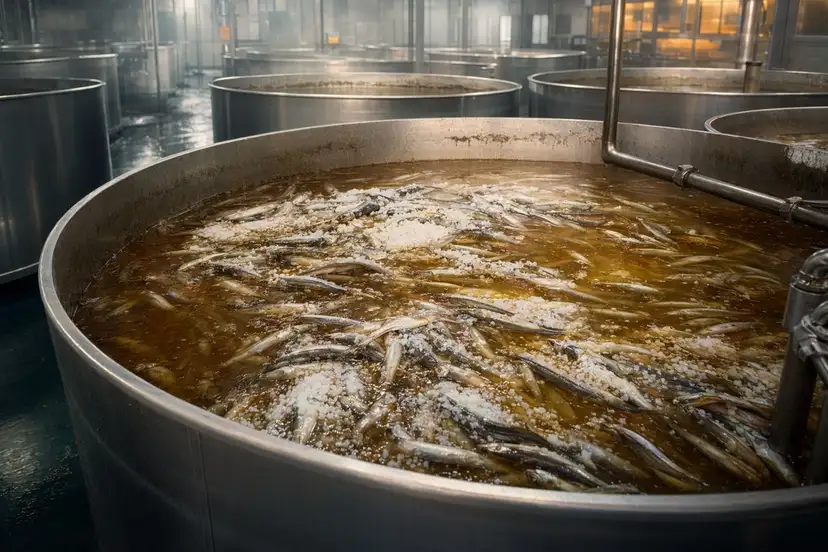
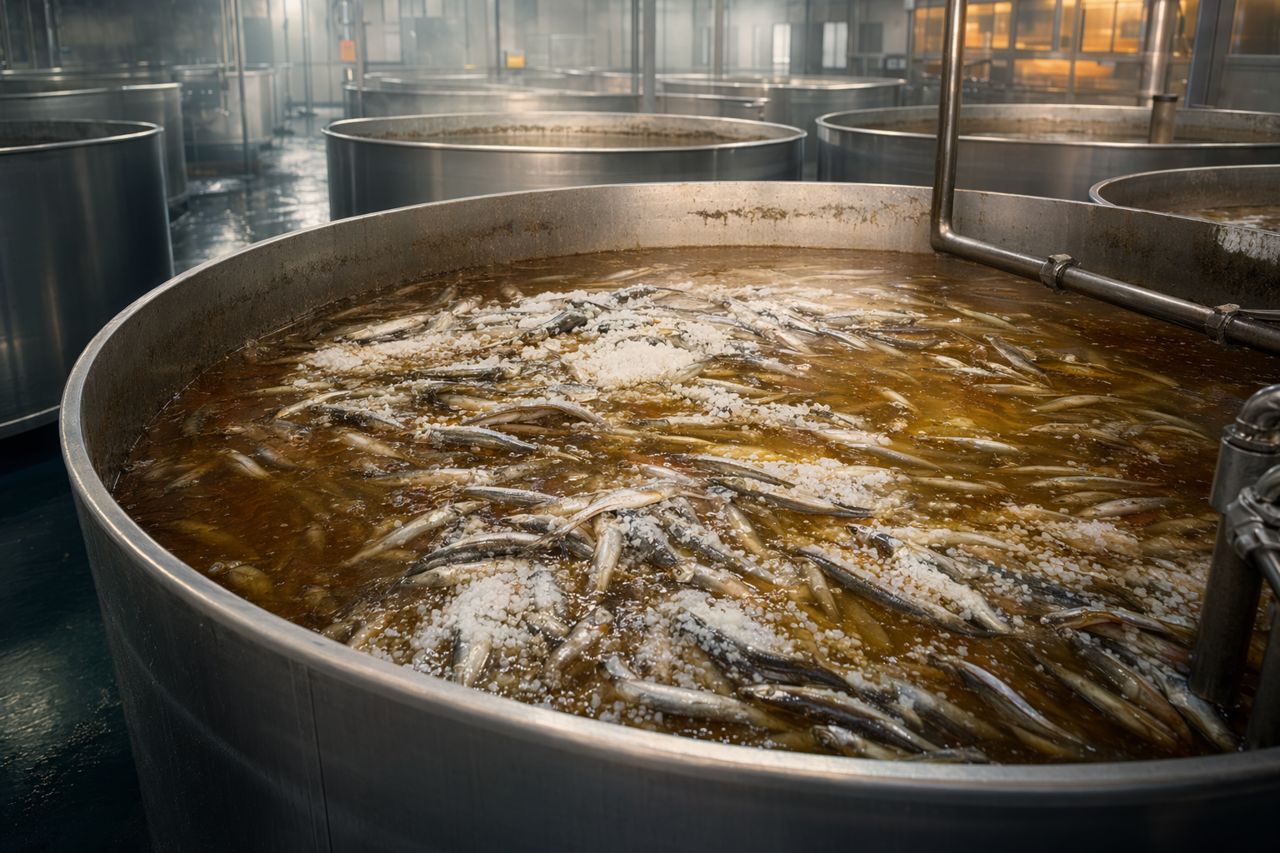
On a spreadsheet, a fish-to-salt ratio can look precise. Inside an industrial vat, the salt environment is dynamic. Salt crystals dissolve at different rates. Brine density shifts as fish liquefies. Protein and oil movement alters local mixing. Temperature gradients affect solubility and diffusion. Large particles may trap pockets of lower-salinity moisture early in the cycle.
This matters because enzymes and microbes experience the vat locally, not as an average. A sample from a convenient tap may not represent the whole batch. A mature plant-scale salt program considers where the brine is moving, where solids settle, and how salt concentration changes during the first critical weeks of fermentation.
Key control points for fermentation managers
- Raw fish condition: Freshness, species mix, particle size, and seasonal fat level affect brine penetration and protein accessibility.
- Salt quality: Crystal size, impurity profile, moisture, and dissolve behavior influence early distribution.
- Layering method: Manual or automated salting patterns can create repeatable or highly variable early brine zones.
- Brine recirculation: Gentle movement helps salinity equalize without stripping away traditional maturation character.
- Sampling map: Top, mid-depth, bottom, and side-wall samples reveal differences a single draw cannot show.
- Correction timing: Early corrections are usually more effective than late-stage rescue blending.
Enzyme performance depends on the salt environment
Industrial fish sauce fermentation relies on endogenous fish enzymes, salt-tolerant microbial activity, and time. Supplemental enzyme systems can help factories improve nitrogen release, shorten bottlenecks, or stabilize production targets, but enzyme selection must respect the salt conditions of the process.
A salt-tolerant enzyme program should be evaluated against practical factory questions:
- Does it remain useful in the plant’s real brine range?
- Does it support clean soluble nitrogen development without flattening aroma?
- Does it reduce maturation variability while preserving recognizable fish sauce character?
- Does it perform across seasonal raw material changes?
- Does it fit existing salting, holding, pressing, and finishing operations?
SaltPulse Bioworks designs recommendations around the fermentation system already in place. The goal is not to make fish sauce taste generic. The goal is to give production managers better control over the traditional transformation.
Brine handling: small decisions, large consequences
Brine is the working medium of the fermentation. It carries salt, soluble peptides, amino nitrogen, minerals, volatile aroma compounds, and process history. Poor brine handling can undo careful formulation.
At industrial scale, attention should be paid to:
Dissolution discipline
Undissolved salt at the bottom of a vat may look reassuring, but it can signal uneven early exposure. A controlled dissolution approach helps reduce low-salinity pockets while maintaining the protective salt profile needed for long fermentation.
Density and stratification
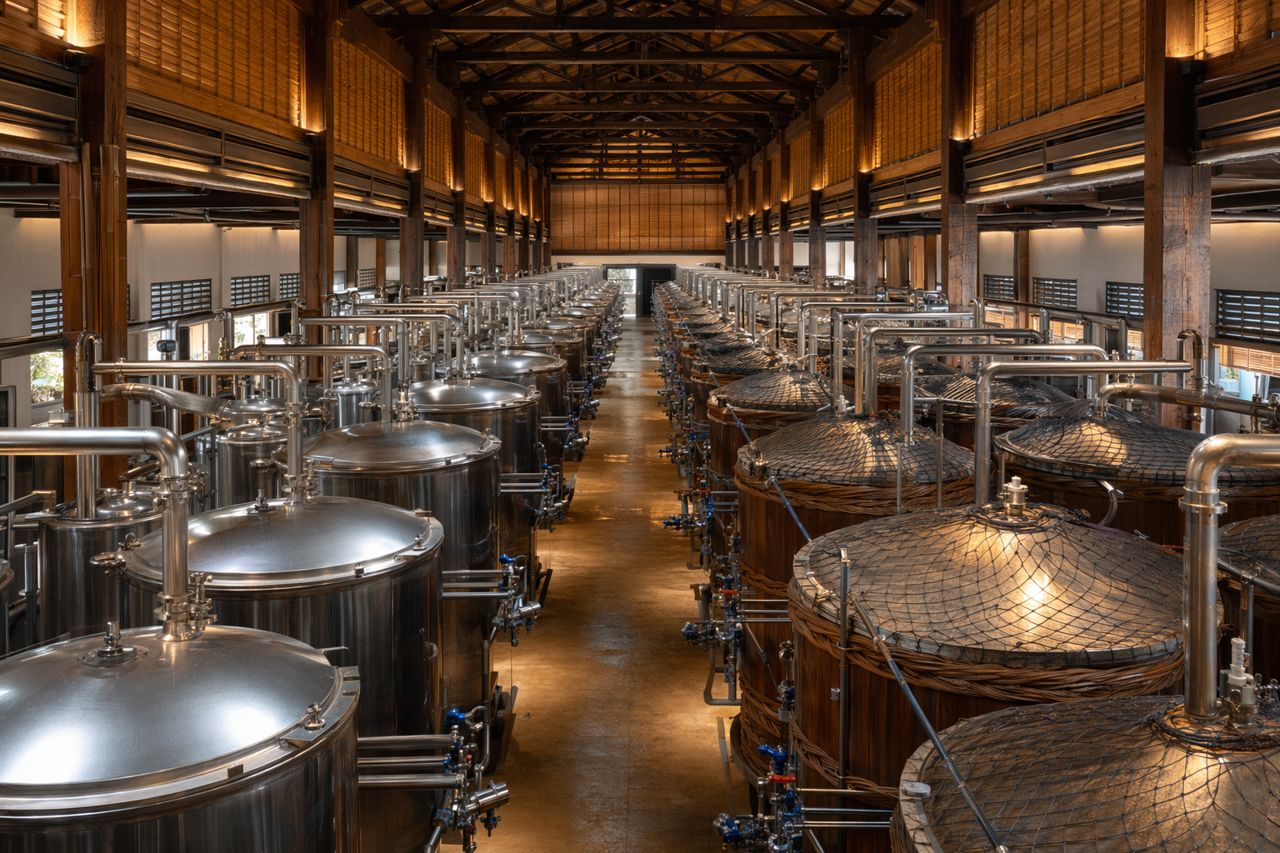
Dense brine may settle while lighter liquid remains above. Without planned movement or staged checks, stratification can slow uniform hydrolysis. Gentle recirculation, scheduled draw-and-return, or controlled agitation can improve consistency when matched to the plant’s traditional method.
Sanitary transfer design
Brine transfer lines, pumps, and holding vessels should be managed as part of the fermentation system. Residual protein films, dead legs, and inconsistent cleaning practices can introduce avoidable aroma drift and contamination risk.
Evaporation and concentration
Open or semi-open systems can concentrate salt over time. Covered systems may behave differently. Seasonal humidity and heat can alter the effective salinity curve, especially in long maturation programs.
Linking salt control to nitrogen release
Fish sauce value is closely tied to the formation of soluble nitrogen compounds and the sensory depth they create. Salt influences how quickly proteins become accessible, how enzymes act, and how the liquid phase carries breakdown products.
When salinity is controlled well, factories often see a more predictable progression:
- Early brine penetration into fish tissue
- Controlled protein solubilization without unstable spoilage notes
- Steady peptide formation supporting body and mouthfeel
- Gradual amino nitrogen development supporting umami intensity
- Cleaner separation as insoluble material becomes easier to manage
- More consistent blending lots at finishing
The production benefit is not only speed. It is confidence: knowing whether a batch is on track early enough to adjust.
Aroma maturity is a salt-managed outcome
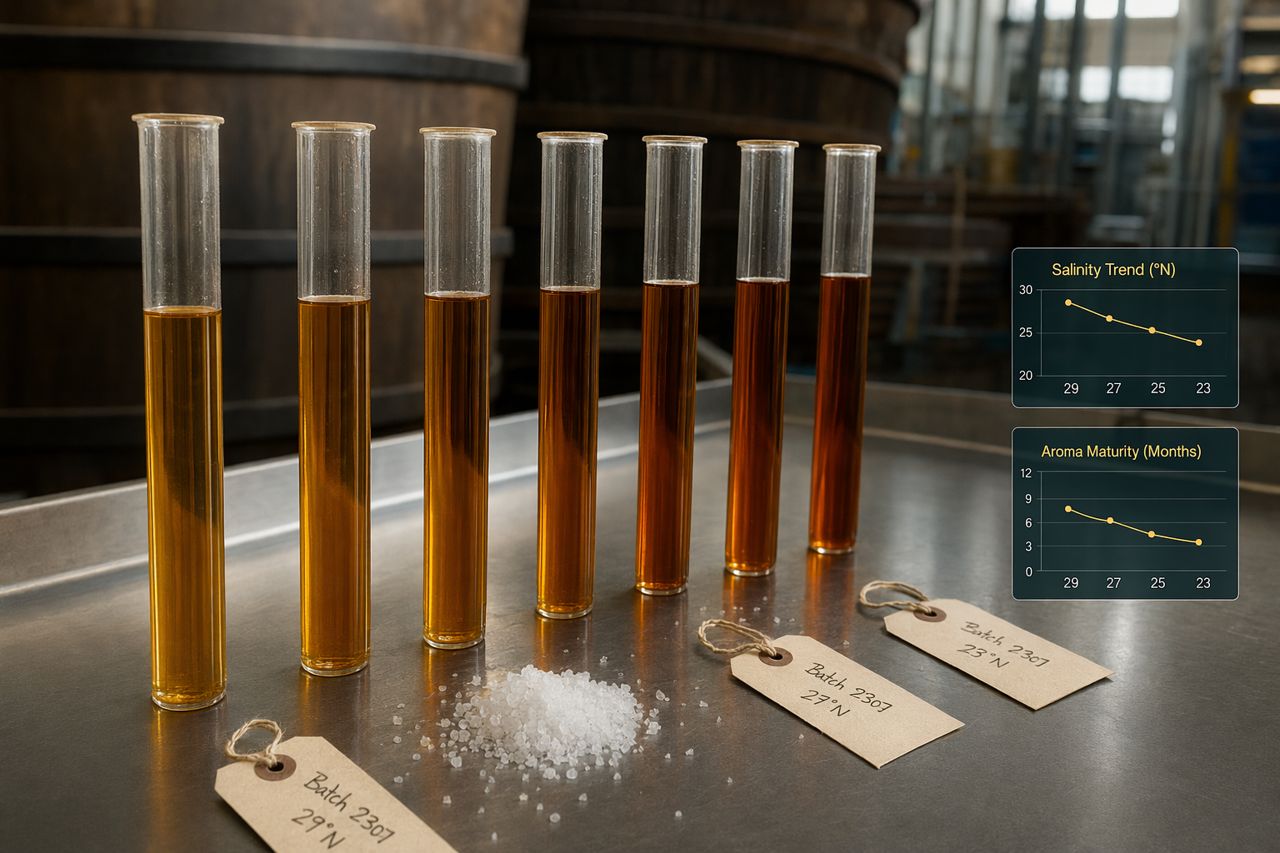
Fish sauce aroma is built slowly. Sharp marine notes soften. Harsh protein breakdown odors recede. Amber, savory, roasted, dried seafood, and fermented notes become more integrated. Salt management affects this arc because it controls which reactions dominate at each stage.
Too much process acceleration can strip complexity. Too little control can leave tanks occupied for longer than planned. The best enzyme and salinity strategy respects the factory’s target aroma profile while improving the reliability of getting there.
For premium lines, that may mean subtle support for more consistent maturity. For volume lines, it may mean reducing outlier batches and stabilizing release schedules. In both cases, the work begins with the brine.
Practical salinity program for fish sauce factories
A strong plant program does not need to be complicated, but it does need to be disciplined.
1. Define the target salinity window by product line
Premium first-press sauce, blended sauce, and accelerated production streams may not need the same salt curve. Establish target windows by line and by fermentation stage, not only by initial formulation.
2. Build a vat sampling map
Document sample points by depth and location. Track differences over time. A simple map can reveal recurring stratification patterns tied to filling method, fish size, salt addition, or vessel geometry.
3. Record salt lot behavior
Salt is an ingredient with operational behavior. Track supplier lot, crystal size, moisture, dissolve time, and observed sediment. If a salt change coincides with fermentation variation, the team should know.
4. Coordinate enzyme addition with salinity reality
If supplemental enzymes are used, add them when the salt and substrate conditions allow useful performance. A formulation that works in one stage may be less effective if the brine is still uneven or if protein accessibility is limited.
5. Review maturation data against sensory panels
Do not manage by numbers alone. Pair salinity and nitrogen trend data with aroma and taste review. Fish sauce is an industrial product, but its value is sensory.
Where SaltPulse Bioworks fits
SaltPulse Bioworks works with fish sauce factories that need dependable fermentation support without losing the identity of their process. We help fermentation and procurement teams assess salt tolerance requirements, enzyme compatibility, process fit, and scale-up risk.
Our role as an enzyme supplier for fish sauce fermentation is to support factory outcomes that matter:
- More consistent nitrogen release between batches
- Better control of maturation timing
- Improved process confidence under high-salt conditions
- Reduced risk when raw fish or salt lots change
- Cleaner scale-up from trial vat to production vessel
- Technical documentation for procurement, QA, and production review
We do not treat fish sauce as a generic hydrolysis project. We treat it as a heritage fermentation that must survive modern production pressure.
Questions to ask before changing the salt or enzyme program
Before modifying salt level, salting sequence, brine circulation, or enzyme addition, align the team on these questions:
- Which product line is the change intended to improve?
- Is the problem speed, aroma consistency, yield, clarification, or batch variation?
- Are salinity measurements taken from enough locations in the vat?
- Is the current enzyme activity limited by salt, access to protein, timing, or temperature?
- How will sensory maturity be judged during the trial?
- What is the smallest plant-scale trial that gives reliable evidence?
Clear answers prevent a technical change from becoming an expensive production guess.
Request a quote for salt-tolerant fermentation enzyme support
If your factory is reviewing salinity control, nitrogen release, maturation time, or batch consistency, SaltPulse Bioworks can help evaluate the enzyme strategy for your process conditions.
Request a quote through our on-site form and share your target product type, salting method, fermentation timeline, and current production challenge. Our team will respond with a practical path for technical review and supply discussion.